
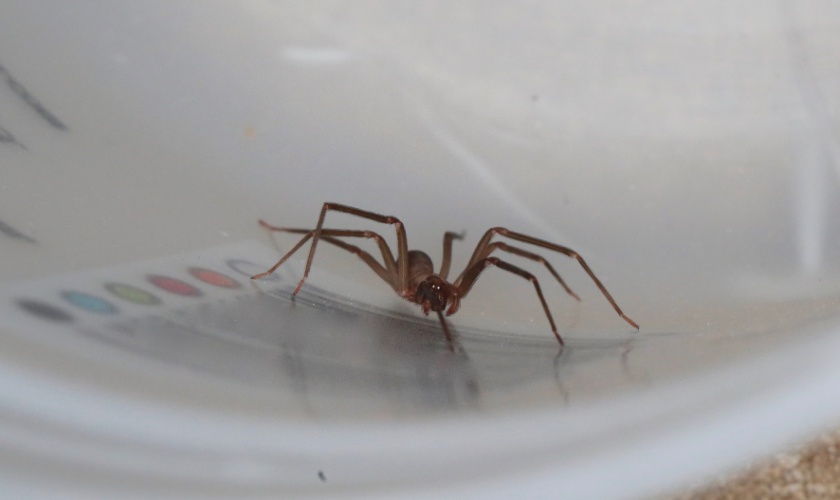
The brown recluse spider is one of the most feared pests in Kentucky. It has a well-established reputation, and some of that reputation is deserved—brown recluse bites can cause serious medical reactions in some cases. But a significant amount of what circulates about this spider is inaccurate, and misinformation leads homeowners to either overreact to spiders that are not brown recluses or underestimate the conditions that allow them to become established in a home.
This guide covers what brown recluse spiders actually are, where they are found in Kentucky, how to identify them accurately, what the real risks are, and what homeowners can do to reduce their presence. X-iT Pest & Wildlife Solutions provides spider control services throughout Lexington and Central Kentucky and regularly assists homeowners dealing with confirmed or suspected brown recluse activity.
Dangerous Spiders in Kentucky: What a Brown Recluse Actually Looks Like
Accurate identification is the starting point for any brown recluse concern, because a large number of spider species in Kentucky are mistaken for brown recluses regularly.
The brown recluse (Loxosceles reclusa) has three identifying characteristics that, taken together, distinguish it reliably from other species:
Six eyes arranged in three pairs. Most spiders have eight eyes. The brown recluse has six, arranged in three dyads in a semicircular pattern. This characteristic requires close examination and is not easily observed without magnification, but it is definitive.
A violin-shaped marking on the cephalothorax. The dark, violin-shaped pattern on the top of the front body segment—with the neck of the violin pointing toward the abdomen—is the feature most people associate with the brown recluse. It is a useful identifier, but it is not unique to this species, and it can be faint or absent in younger spiders. Relying solely on this marking leads to frequent misidentification.
Uniform coloration on the abdomen. The brown recluse abdomen is uniformly colored—tan to dark brown—with no stripes, spots, or banding. Many spiders misidentified as brown recluses have patterned abdomens, which rules them out.
Body size ranges from roughly a quarter inch to three-quarters of an inch in body length, with leg span reaching up to an inch and a half. They are not large spiders. Their legs are long relative to body size, slender, and lack visible spines.
Brown Recluse Lexington KY: Where are they?
Brown recluse spiders are present in Kentucky, including in Fayette County and the broader Central Kentucky region. Kentucky sits within the documented range of the species, which extends through the south-central United States from Nebraska and Kansas south through Texas and east through Tennessee and Kentucky.
Within a structure, brown recluses are found in dry, undisturbed spaces where they are unlikely to be encountered by larger animals or humans. Common locations include:
- Cardboard boxes and storage containers in basements and attics
- Spaces behind and beneath furniture that is rarely moved
- Inside clothing, shoes, and gloves that have been stored for extended periods
- Behind wall hangings and in gaps behind baseboards
- Inside seldom-used utility spaces, under appliances, and behind water heaters
- Attic insulation and spaces between stored items
They are not web-building hunters in the typical sense. Brown recluses build irregular, loosely structured webs that serve as retreats rather than prey-capture structures. They hunt at night and spend the majority of their time hidden.
Common Myths About Brown Recluse Spiders
Myth: Any spider bite that causes a skin lesion is a brown recluse bite.
This is one of the most persistent and consequential misconceptions. Many conditions—including bacterial skin infections, other arthropod bites, fungal infections, and unrelated dermatological conditions—produce skin lesions that are attributed to brown recluse bites. In regions where brown recluses are not present at all, physicians still regularly report brown recluse bite diagnoses, which indicates the degree to which this spider is blamed for a wide range of unrelated conditions. A bite should only be attributed to a brown recluse when the spider has been captured and positively identified or when the diagnosis is confirmed by a physician with direct evidence.
Myth: Brown recluses are aggressive.
The name “recluse” is accurate. These spiders actively avoid contact with humans and will retreat when given the opportunity. The majority of bites occur when a spider is accidentally pressed against skin—inside clothing being put on, inside a shoe, or when a person reaches into a space where the spider is resting. Unprovoked attacks do not occur.
Myth: Brown recluse bites always cause severe tissue damage.
Necrotic skin lesions are a possible outcome of a brown recluse bite, but they are not the typical outcome. Research suggests that a significant portion of brown recluse bites result in minor reactions or no significant tissue reaction at all. Severe necrosis is more common in individuals with certain immune conditions. The severity of a bite is not predictable in advance, which is why any suspected bite warrants medical attention, but homeowners should not assume that any brown recluse encounter will result in serious injury.
Myth: Brown recluses are everywhere in Kentucky.
Brown recluses are present in Kentucky, but their distribution is not uniform. They are more concentrated in southern and western Kentucky than in the central and eastern parts of the state, though they are documented in Fayette County. Population densities inside structures vary enormously—some infested homes contain hundreds of individuals, while others have isolated spiders with no established population.
Are They Actually Aggressive? Understanding Real Risk
The honest answer is that the risk from brown recluse spiders in a Kentucky home is real but frequently overstated. The species is present, bites do occur, and a subset of bites can cause significant medical problems. At the same time, people live in homes with brown recluse populations for years without being bitten, and the spider’s instinct is consistently to avoid rather than confront.
The highest-risk scenarios involve disturbing harborage areas without caution—reaching bare-handed into storage boxes, putting on clothing or shoes that have been stored in infested spaces without shaking them out first, or moving furniture and boxes in areas of known activity without protective gloves.
Medical attention is appropriate for any spider bite that produces a spreading lesion, significant pain beyond the immediate bite site, or systemic symptoms including fever, chills, or nausea. Bringing the spider to the appointment for identification, if it was captured, improves the accuracy of the diagnosis and treatment.
Prevention Strategies for Lexington Homeowners
Reducing brown recluse activity in a home involves addressing both the harborage conditions they rely on and the entry points through which they access the structure.
- Reduce clutter in storage areas: Cardboard boxes stacked in basements and attics are ideal brown recluse habitat. Replacing cardboard storage with sealed plastic bins eliminates a significant portion of available harborage. Reducing the overall volume of undisturbed storage areas reduces habitat.
- Shake out clothing and footwear: Shoes, boots, gloves, and clothing stored in basements, garages, or infrequently used closets should be shaken out before wearing, particularly if the area has a history of spider activity.
- Move storage away from walls: Brown recluses travel along walls and prefer harborage in contact with vertical surfaces. Keeping stored items a few inches away from walls reduces the connectivity between travel routes and harborage sites.
- Seal entry points: Brown recluses enter structures through gaps around utility penetrations, under doors, through foundation cracks, and through openings around windows. Systematic sealing of these entry points as part of general pest exclusion work reduces access.
- Reduce prey populations: Brown recluses feed on small insects. Properties with significant insect activity inside the structure support larger spider populations. Addressing the underlying insect issues reduces the food supply that supports spiders.
- Use sticky traps: Glue board traps placed along baseboards and in corners of storage areas are effective for monitoring brown recluse activity and can help reduce populations when placed in areas of known activity. They are also useful for confirming whether a spider observed in the home is actually a brown recluse.
When to Call a Professional
Isolated spider sightings in a home do not necessarily indicate an established population. However, repeated sightings, spider egg sacs in storage areas, or multiple individuals found in a short period suggest that spiders are living and reproducing inside the structure rather than entering as occasional strays.
Professional inspection and treatment are the appropriate responses when you suspect an established population. X-iT Pest & Wildlife Solutions provides spider control services throughout Lexington and the surrounding area, including inspection of common harborage areas and targeted treatment for confirmed activity. Schedule an inspection if you have ongoing spider concerns in your home.